
Mukesh kumar masoom
Mumbai . Rising from poverty and hardship to achieve great heights through one’s own talent is not an easy task. But when a person possesses the passion to fulfill dreams, the strength of hard work, and the light of self-confidence, even circumstances bow before such determination. The inspiring story of Mukesh Kumar Masoom reflects this very spirit. Breaking the chains of poverty, he has established a distinguished identity in the fields of literature, journalism, and Bollywood.
Today, the name “Masoom” is not merely a person’s name; it has become a powerful identity. Through his words and creative brilliance, Mukesh Kumar Masoom has turned this name into a strong brand. The songs written by him are continuously gaining popularity. His notable songs “Dil Ka Khuda” (sung by Padma Shri and Padma Bhushan awardee Udit Narayan) and “Us Bedardi Ne Dil Toda” (sung by Agam Kumar Nigam) are highly appreciated among music lovers. Hundreds of his songs are also lined up for release in the coming years.
Apart from his creative achievements, his revolutionary thoughts and generosity have transformed many lives. During the lockdown period, he extended financial help to thousands of people. The boy who once walked barefoot now travels in luxurious cars and frequently flies by air. The child who once lived in a slum now resides in a grand bungalow in Mumbai.
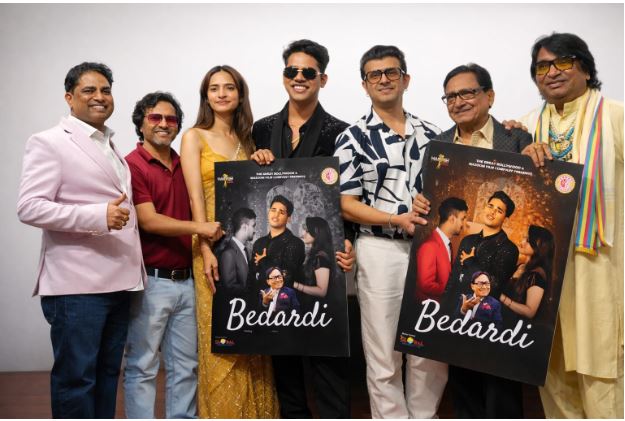
Lyricist Mukesh Kumar Masoom with Padma Shri Sonu Nigam, music composer Dilip Sen, legendary singer Agam Kumar Nigam, Hero Sangeet Masoom, Asia Masoom and Kailash Masoom during the release of the music album ‘Bedardi’.”
Mukesh Kumar Masoom is not only a lyricist but also a sensitive writer, a sharp thinker, and a versatile creator. The greatest strength of his writing lies in expressing deep truths of life and human emotions in simple language. This is why his works directly touch the hearts of readers and listeners.
Childhood Filled with Hardships :
Mukesh Kumar Masoom was born on 13 July 1974 in Dayanatpur village (Jewar), Greater Noida, Uttar Pradesh, in a modest laborer’s family. From an early age, life introduced him to struggles. At an age when children usually hold books and toys, his hands were occupied with labor and sewing tools.
The financial condition of the family was so weak that paying school fees often became impossible, and sometimes there was not even enough food at home. Yet these hardships could not weaken his confidence or his love for education. With determination and hard work, he continued his studies and later completed M.A. and LL.B. degrees. Currently, he is also engaged in Ph.D. research work.
Reached Mumbai with Just Five Rupees :
In search of a better future, he arrived in Mumbai on 22 April 1992, carrying only five rupees and two dry rotis in his pocket. He had no friends, no relatives, and no support—only the courage to turn his dreams into reality.
His early days in Mumbai were extremely difficult. He worked day and night in sewing factories. Many times the needle of the sewing machine would break and pierce his fingers, but due to financial hardship he could not even afford proper medical treatment. After applying basic medicine, he would return to work. However, these struggles never broke his spirit; instead, they made him stronger.
A Strong Identity in: Literature and Cinema
Mukesh Kumar Masoom is a member of the Screenwriters Association (SWA) and the Indian Motion Pictures Producers’ Association (IMPPA). In Bollywood, he is recognized as a respected lyricist whose songs have been sung by many renowned singers.

“Former President of India Ram Nath Kovind felicitating Mukesh Kumar Masoom. Also seen are Union Minister of State for Social Justice and Empowerment Ramdas Athawale and MLC Dr. Lalji Prasad Nirmal.”
Some of his popular songs include “Dil Todne Wala Dil Ka Khud Nikla” (Udit Narayan), “Daaru Cigarette Chhod De” (Mamta Sharma), “Jeevan Ek Amrit Hai” (Udit Narayan), “Bhagwan Zaroori Hai” (Altamash Faridi), “Khatu Shyam Jana Hai” (Anup Jalota), “Jai Bhim Bolo Re” (Mohammed Aziz), “Breakup Party” (Harman Nazim), “Menu Hanske Vida Kar De” (Shabab Sabri) and “Us Bedardi Ne Dil Toda” (Agam Kumar Nigam). His song from the film “Dhanno Dhabe Wali” also received significant appreciation.
Contribution to Literature and Journalism :
In the literary field, several of his works have been published, including his well-known book “Gulistan.” His audiobooks “Pandit Ji Ka Lota,” “Punaravritti,” and “Bade Dilwala” are available on digital platforms and are appreciated both in India and abroad.
In journalism as well, he has made remarkable contributions. For many years, he served as an editor in a multilingual group of seven daily newspapers in Mumbai, where he consistently raised important social issues through his writings.
Honors and achievement :
For his literary and cultural contributions, Mukesh Kumar Masoom has been honored with several prestigious awards. He has received the “Kavi Bhushan Samman” and the “Pandit Deendayal Upadhyay Award.” He has also been honored by the former President of India, Ram Nath Kovind, in recognition of his significant contributions.
A Source of इंस्पिरेशन :
From a childhood filled with poverty and struggles to establishing a respected identity in literature and Bollywood, his journey has become a source of inspiration for millions of young people. His life sends a powerful message: with strong determination and relentless hard work, any individual can rise from ordinary circumstances to achieve extraordinary success.
Today, Mukesh Kumar Masoom is not just a lyricist or a writer; he stands as a living symbol of perseverance and success, and a beacon of hope for the new generation.