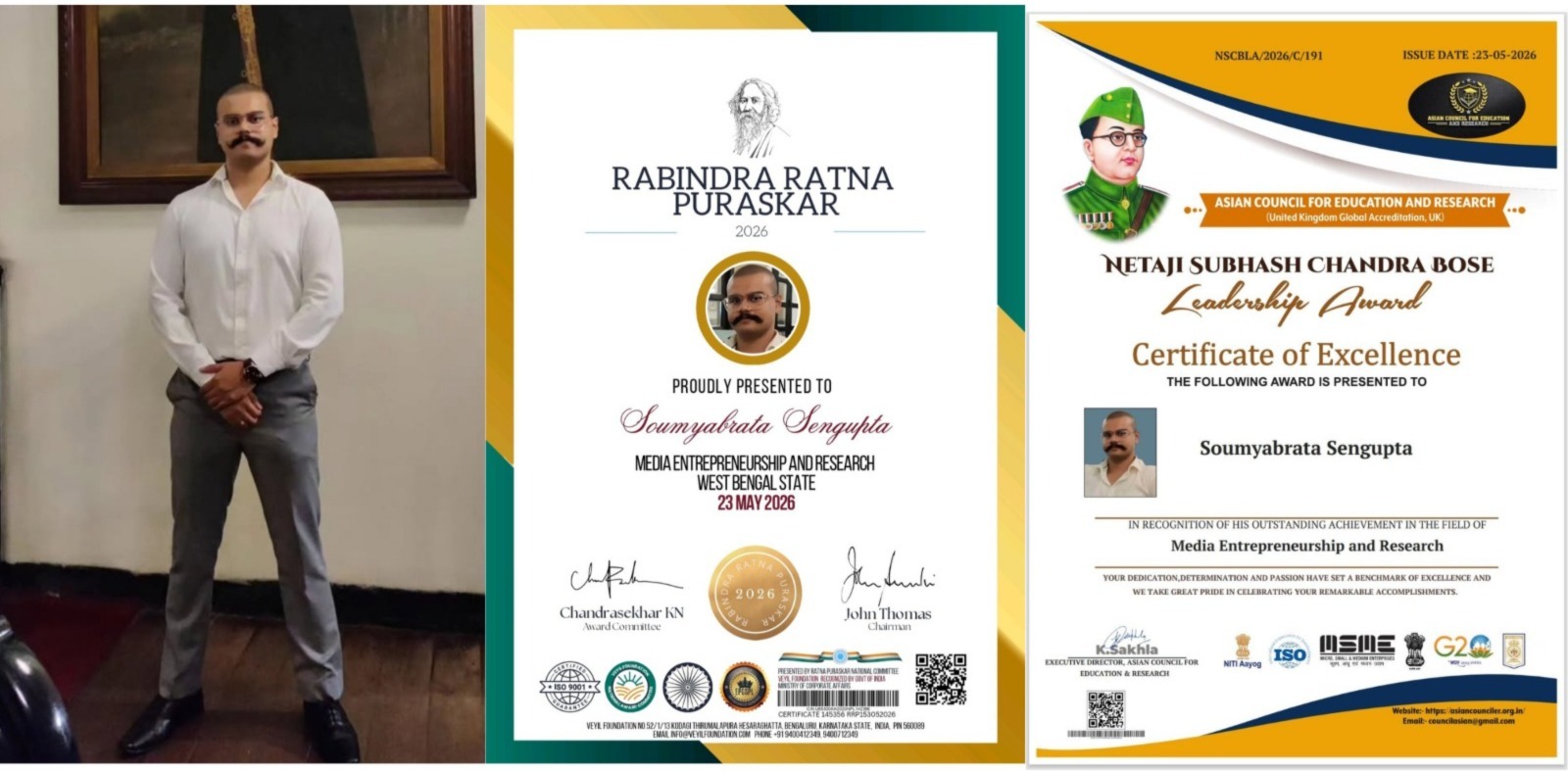
Kolkata-based media entrepreneur and researcher Soumyabrata Sengupta was conferred two honours on May 23, 2026, for his work across media entrepreneurship, strategic communications, research and public discourse.
Sengupta received the Rabindra Ratna Puraskar 2026, presented by the Indian NGO Awards Council, along with the Netaji Subhash Chandra Bose Leadership Award, awarded by the Asian Council for Education and Research. The honours recognised his contributions to media studies, political communication, digital narratives and research-oriented public affairs initiatives.
The dual recognition comes at a time when Sengupta’s work has increasingly drawn attention in sections of India’s media and research circles for its focus on the relationship between technology, communication systems and public perception in contemporary society.
Over the last several years, he has been associated with projects spanning media entrepreneurship, strategic communications, research and long-form writing. His work has explored subjects ranging from digital narratives and political communication to institutional behaviour, media systems and the growing influence of information networks on public life.
The Indian NGO Awards Council, in its citation accompanying the Rabindra Ratna Puraskar 2026, described Sengupta as “a distinguished media entrepreneur, researcher, and strategic communications professional” whose work has made “indelible contributions to the fields of media studies, political communication, digital narratives, and public affairs.”
The citation further noted that his work engages with “the intricate intersections between technology, conflict, society, and institutional communication,” while highlighting his research into how media systems shape public perception and contemporary political discourse.
According to the citation, Sengupta’s work has sought to examine the evolving influence of information systems in contemporary India and the role media increasingly plays in shaping public understanding, institutional narratives and policy conversations.
People familiar with Sengupta’s recent work say he has increasingly shifted away from operational public-affairs activity toward research, writing and institutional analysis. His books and ongoing research have focused particularly on the relationship between media systems, conflict, technology and public behaviour.
Associates say the simultaneous conferring of both honours reflects the unusual breadth of Sengupta’s work during a period in which media, technology and politics have become deeply interconnected in India’s public sphere.
Despite maintaining a relatively low public profile compared to many contemporary media entrepreneurs, Sengupta’s work has gradually attracted attention among sections of India’s strategic affairs, media and academic communities for its interdisciplinary approach to communication, technology and society.
Those familiar with his work say the recognition may mark another stage in his transition toward a more research-oriented public role focused on media systems, political communication and institutional analysis.