
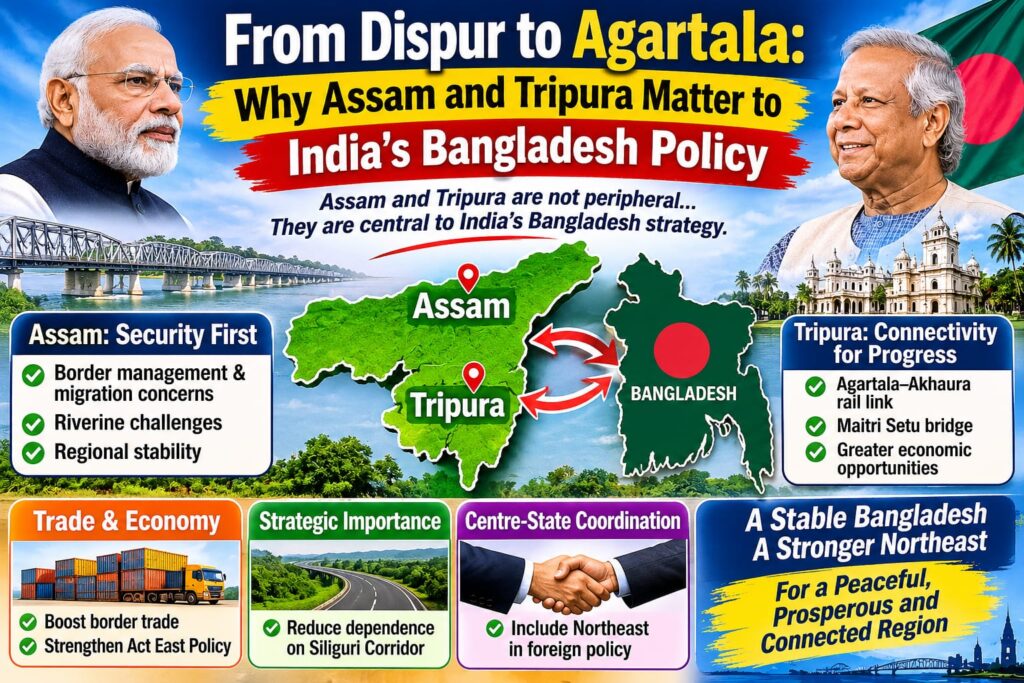
New Delhi: India’s relationship with Bangladesh is not shaped by diplomatic engagements between New Delhi and Dhaka alone. The security concerns, economic interests and geographical realities of northeastern states, particularly Assam and Tripura, play an equally important role in determining the future of bilateral relations.
As India reassesses its engagement with Bangladesh amid political changes in Dhaka, the strategic importance of these two northeastern states is receiving renewed attention. Their shared borders, historical connections, trade interests and security challenges make them essential stakeholders in India’s neighbourhood policy.
India and Bangladesh share a 4,096.7-kilometre international border across five Indian states: West Bengal, Assam, Meghalaya, Tripura and Mizoram. Assam shares approximately 263 kilometres of the border, while Tripura accounts for around 856 kilometres.
These geographical realities mean that developments in Bangladesh have a direct impact on the security, economic activities and social environment of communities living in India’s Northeast.
Assam: Border security and migration remain key concerns
Assam occupies a sensitive position in India’s Bangladesh policy because of its historical experience with cross-border migration, demographic concerns and internal security challenges.
The Assam Movement of 1979–1985 and the subsequent Assam Accord established migration as a major political and administrative issue in the state. Debates surrounding the National Register of Citizens (NRC) and citizenship legislation have further highlighted the continuing sensitivity of the subject.
For New Delhi, effective border management remains essential to prevent unauthorised crossings, human trafficking, smuggling and other cross-border criminal activities.
However, Assam’s riverine border presents significant challenges. Changing river channels, erosion and seasonal flooding make surveillance difficult in several areas.
Strengthening coordination between the Border Security Force (BSF) and Border Guard Bangladesh (BGB), alongside modern surveillance technology and intelligence sharing, is therefore important.
At the same time, border management must follow lawful procedures and distinguish between genuine security threats, legitimate cross-border movement and the rights of Indian citizens.
Assam’s experience demonstrates that effective relations with Bangladesh require a combination of strong border security, responsible administration and diplomatic cooperation.
Tripura: Connectivity offers major economic opportunities
Unlike Assam, whose Bangladesh-related concerns are frequently associated with security and migration, Tripura highlights the economic and strategic benefits of geographical connectivity.
Surrounded by Bangladesh on three sides, Tripura has historically faced transportation challenges because the Partition of 1947 disrupted traditional routes connecting the region with the rest of the subcontinent.
Improved connectivity through Bangladesh could significantly reduce transportation distances and strengthen the state’s economic prospects.
The Agartala–Akhaura railway link, inaugurated in November 2023, represents an important step towards improving cross-border railway connectivity.
Another major project is Maitri Setu, a bridge over the Feni River connecting Sabroom in Tripura with Ramgarh in Bangladesh. Inaugurated in March 2021, the project was designed to improve access towards Bangladesh’s Chattogram Port.
However, the full economic benefits of such infrastructure depend on operational arrangements, customs facilities, transit permissions and effective cross-border coordination.
For India, these projects could provide alternative logistical routes for the wider Northeast, reduce dependence on traditional transportation corridors and strengthen regional trade.
Trade and economic cooperation need greater attention
Assam and Tripura are also important centres of India-Bangladesh commercial engagement.
Border trading facilities such as Sutarkandi in Assam and Agartala and Srimantapur in Tripura facilitate trade between businesses and local communities.
The Barak Valley in Assam offers opportunities for improved road, railway and inland-waterway connectivity with Bangladesh. The India-Bangladesh Protocol on Inland Water Transit and Trade also provides a framework for expanding commercial transportation.
These initiatives complement India’s Act East Policy, which aims to strengthen economic and strategic engagement with Southeast Asia through improved regional connectivity.
However, trade restrictions introduced in 2025 on certain Bangladeshi imports through northeastern land customs stations demonstrated how national commercial decisions can directly affect border-state economies.
According to the figures cited in the available material, trade handled at Sutarkandi declined from approximately ₹307 crore in 2024–25 to ₹242 crore in 2025–26.
The figures underline the importance of assessing the regional economic consequences of national trade policies.
India must protect its domestic industries while ensuring that legitimate businesses and border communities are not unnecessarily disadvantaged.
Bangladesh’s political transition and India’s strategic interests
Political developments in Bangladesh since August 2024 have created a changing diplomatic environment for India.
The political transition and the formation of a government led by Tarique Rahman in 2026 have added a new dimension to bilateral engagement.
For New Delhi, maintaining constructive relations with Dhaka is important irrespective of changes in political leadership.
Assam and Tripura have particularly significant interests in maintaining security cooperation with Bangladesh. Previous cooperation against insurgent networks and transnational criminal activities has contributed to improving stability in India’s Northeast.
Preserving these channels of cooperation should remain a priority.
India must also approach Bangladesh’s engagement with other regional powers with strategic maturity. Diplomatic relationships maintained by Dhaka with other countries should be assessed on the basis of their actual implications for India’s security and economic interests.
Stronger coordination between the Centre and northeastern states
India’s Bangladesh policy would benefit from a more institutionalised approach involving northeastern state governments.
Regular consultations between the Union government, Assam, Tripura and other border states could improve coordination on security, infrastructure, trade and connectivity.
Existing infrastructure projects should be made commercially viable through effective customs facilities, transit arrangements and cross-border logistics.
Similarly, modern border surveillance and intelligence cooperation should be accompanied by efficient systems that facilitate legitimate trade and movement.
Greater participation by northeastern businesses, agricultural producers, transport operators and small enterprises could also help ensure that connectivity projects generate tangible economic benefits.
Education, tourism, cultural exchanges and people-to-people contacts can further strengthen the historical and social connections between communities on both sides of the border.
Northeast remains central to India’s Bangladesh policy
Assam and Tripura represent two important dimensions of India’s relationship with Bangladesh.
While Assam highlights the importance of border security, migration-related concerns and regional stability, Tripura demonstrates the economic opportunities created by improved connectivity and cross-border trade.
For New Delhi, the challenge is to ensure that legitimate regional concerns are reflected in national policymaking without allowing domestic political pressures to undermine broader diplomatic objectives.
A stable Bangladesh is strategically important for India. Equally, a secure and economically prosperous Northeast strengthens India’s regional position and creates opportunities for greater cooperation.
Ultimately, Assam and Tripura are not peripheral to India’s Bangladesh policy. They are among the regions where the success of that policy is most directly experienced.
A balanced strategy combining diplomatic engagement, effective border management, economic cooperation and stronger federal coordination will be essential for building a stable and mutually beneficial India-Bangladesh partnership.